Selling a Home in Boulder City
Boulder City began as a federal townsite for the builders of Hoover Dam, and it still keeps its own pace. Selling a longtime home here comes with a few local quirks worth understanding.
- Cash purchase, as the house stands
- No repairs or clean-out needed
- No agent commission on a direct sale
- You choose the closing date
- Family welcome on every call
A government town that became a city
The Bureau of Reclamation laid out Boulder City in 1931 to house dam workers, and for decades the federal government held title to the land. Congress passed the Boulder City Act in 1958, and the town incorporated in January 1960. Its charter still prohibits gaming, which makes it unusual in Nevada, and voters approved a controlled growth ordinance in 1979 that caps the number of new home permits each year. Local questions go to the City of Boulder City, which also provides some utility services that other valley cities leave to outside companies.
For a seller, the slow-growth rules mainly mean that existing homes, not new construction, make up most of what changes hands.
Dam-era cottages and later ranch homes
Inside the historic district
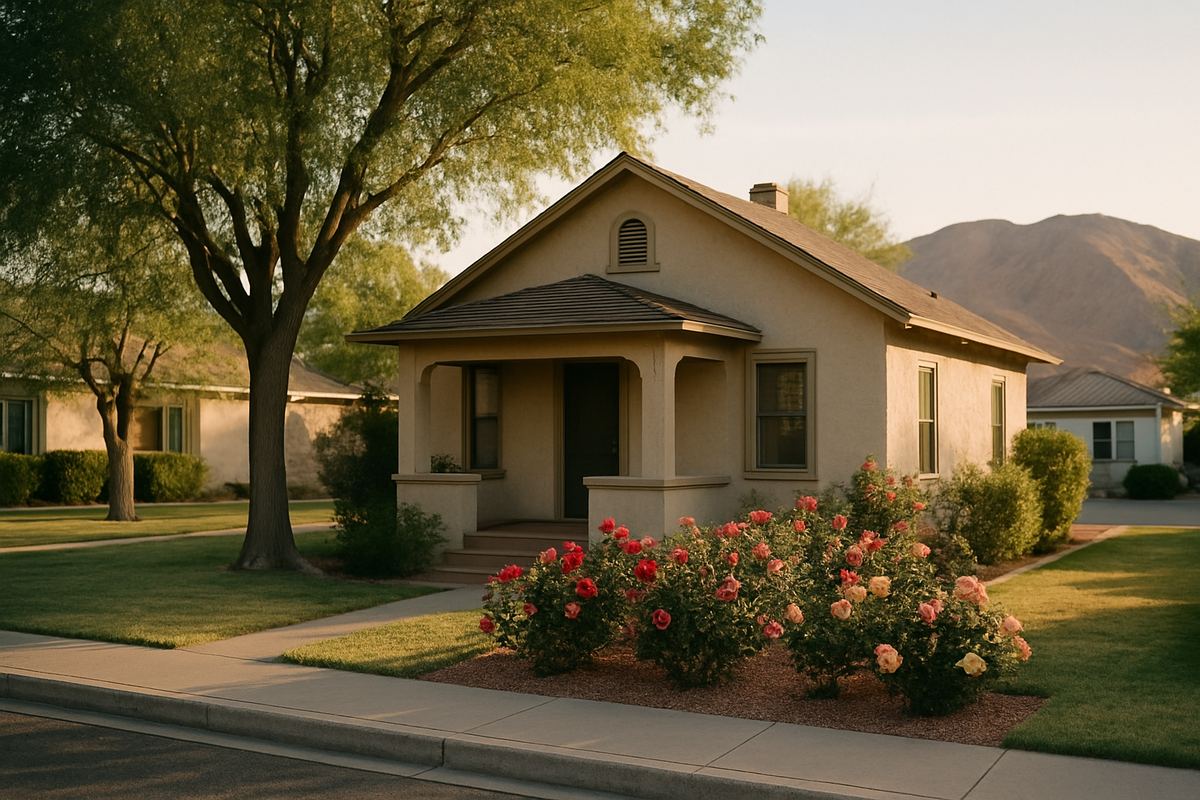
The Boulder City Historic District, listed on the National Register of Historic Places in 1983, covers much of the original townsite, where cottages and managers' houses went up in the 1930s and early 1940s. Many have been added onto over the years, and some still sit on narrow lots shaded by trees planted when the town was young. Exterior changes in the district may involve city review, but because we buy as-is, a seller does not need to plan any work.
Neighborhoods built later
Beyond the old townsite, ranch homes from the postwar decades and later hillside subdivisions offer single-story living with views toward Lake Mead country. Many older streets have no association, while some newer tracts do, so check recent mail for any statements.
Talk It Over Before Anything Is Decided
Send the address and a few words about the move. A local person reads every note, phones you back, and answers questions for you and for anyone in the family you would like on the call.
If speaking is easier than writing, press the red TALK TO ALEX button and you will reach us by phone.
A senior center at the heart of town

The Senior Center of Boulder City, a nonprofit on Arizona Street, has served older residents since the mid-1980s with meals, activities, and a food pantry. For many owners it is where friendships live, and staying close to it can influence where they move next, whether that is a smaller place in town or a room near family elsewhere.
Families sometimes underestimate how much a small town carries a person. The pharmacist knows the prescriptions, the neighbor checks the porch light, and the walk to the post office is a daily visit. Before a sale, it helps to talk about which of those routines can travel and which will need replacing in the next home. We are glad to wait while that conversation happens, and the closing date can be set well after it.
Reasons Boulder City owners decide to sell
Moving closer to children
Boulder City's quiet appeal can feel isolating when driving gets harder. The page on moving into a son's or daughter's home covers how to time the sale around that change.
Generations of belongings
Older Boulder City homes sometimes hold tools, letters, and furniture dating back many decades. Our guide to letting go of a house filled with family history offers a gentle order for sorting, and anything left behind is fine with us.
A relative signing on the owner's behalf
When an owner can no longer manage paperwork, an agent named in a durable power of attorney may sign. Read how a Nevada power of attorney sale works before gathering documents.
Over the pass toward Henderson
The nearest neighborhood we cover is Green Valley on Henderson's east side, where homes are newer and associations more common. Our overview of the neighborhoods where we buy lists each one.
In Boulder City, as everywhere else, our purchase is cash, the cottage or ranch home needs no repairs or cleaning, no agent commission comes out of the proceeds, and the owner decides when closing day falls. The description of our sale process from start to finish explains each stage.
Things Families Often Wonder
Does the historic district make my cottage harder to sell?
Not to us. Historic district status may affect certain exterior changes a future owner wants to make, and the city can explain any review process. Since we buy as-is, you will not need to repaint, re-roof, or alter anything before closing. Original details such as wood windows or older floors are simply part of the house we are buying.
Does Boulder City's growth ordinance affect my sale?
Not directly. The ordinance caps yearly permits for brand-new residences; it places no limit on selling a house that already stands. It mostly explains why the town has kept its small feel. Your sale follows the usual steps of an agreement, a title search, and a closing date that you choose.
My mother's utility bills come from the city. Who closes those accounts?
Usually the owner or the person helping her contacts each provider near the closing date to arrange a final reading and transfer. In Boulder City some services are billed by the city itself, so a call to the city's utility office is a sensible first step. The title company can tell you which accounts, if any, need to be settled through escrow.